
Love What Is: The Mental Game Shift Every Golfer Needs
Author Byron Katie famously said:
“When you argue with reality, you lose — but only 100% of the time.”
Golf gives us countless opportunities to argue with what’s happening—wind, rain, uneven lies, unpredictable bounces, or greens that don’t roll the way we pictured. But none of those things are the enemy.
They are part of the game itself.
And the moment you stop resisting them, your performance transforms.
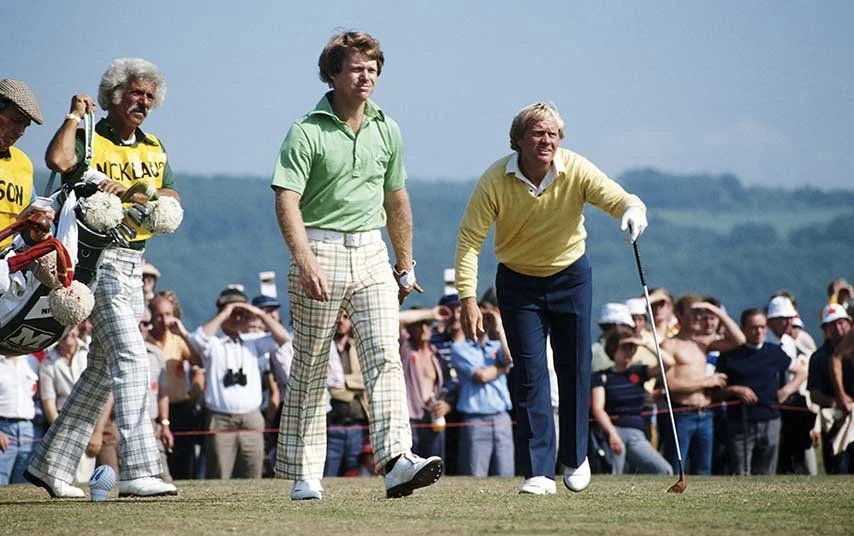
Tom Watson—winner of five Open Championships—is pictured here with Jack Nicklaus during the iconic 1977 final round at Turnberry, forever remembered as “The Duel in the Sun.”
🎧 Audio Insight: Jeff’s Commentary on Acceptance
Acceptance: The Golfer’s Hidden Competitive Edge
Golf magnifies every aspect of human psychology. When we resist conditions, tension builds. And tension is the enemy of fluid motion, solid contact, and consistent scoring.
Players who thrive aren’t the ones fighting conditions.
They’re the ones adapting to them.
They shift from frustration to curiosity.
From complaining to problem-solving.
From judgment to presence.
When you love what is—even when it’s inconvenient—you unlock the mental game advantage most golfers never access.
Tom Watson: From Fighting the Course to Mastering It
Tom Watson didn’t always love links golf.
In fact, early in his career, he hated it.
He once criticized St Andrews as unfair—too many blind shots, too many quirky bounces, too much unpredictability.
But everything changed during a tour of Scotland with Sandy Tatum, a former USGA president and one of the great gentlemen of the game. Watson began to shift how he saw the course.
Instead of fighting the elements, he partnered with them.
Instead of resenting the bounce, he anticipated it.
Instead of cursing the wind, he used it.
The result?
Five Open Championships.
Nothing about links golf changed.
Watson changed.
And acceptance became his freedom.
The Real Problem Isn’t the Wind — It’s the Resistance
Golfers spend endless energy resisting reality:
Muttering about the breeze
Complaining about rough or greens
Getting irritated by bounces
Comparing conditions to an imaginary ideal
But here’s the breakthrough:
The person with the problem is the person with the problem.
When that truth lands, tension dissolves.
You see with startling clarity:
It was never the wind.
It was never the course.
It was never the lie.
It was the resistance to them.
Problems rarely live in the world itself—they live in our perception.
The moment you stop needing reality to be different than it is, the “problem” loses its power.
What’s left is pure golf.
Pure presence.
Pure potential.
Acceptance Isn’t Weakness — It’s Strength
Many golfers confuse acceptance with resignation.
But real acceptance is courage.
It’s choosing clarity over frustration.
It’s meeting the moment without conflict.
It’s playing the shot that exists—not the one you wish you had.
When you stop resisting, performance improves because your mind becomes unified, not divided between “what is” and “what should be.”
The conditions stay the same.
But you change.
And when you change, your results follow.
Reflection — On the Course
When the conditions shift, can you release judgment and meet them as part of the game?
How does your performance change when you stop resisting and start adapting?
Reflection — Off the Course
Where in your life are you arguing with reality?
What would acceptance look like there?
How much energy could you reclaim by moving from resistance to response?
Mantra
“Peace begins where resistance ends.”
Ready To Elevate Your Game?
Learn More About Golf Instruction with Jeff Ritter
